

Bangalore School of Startups
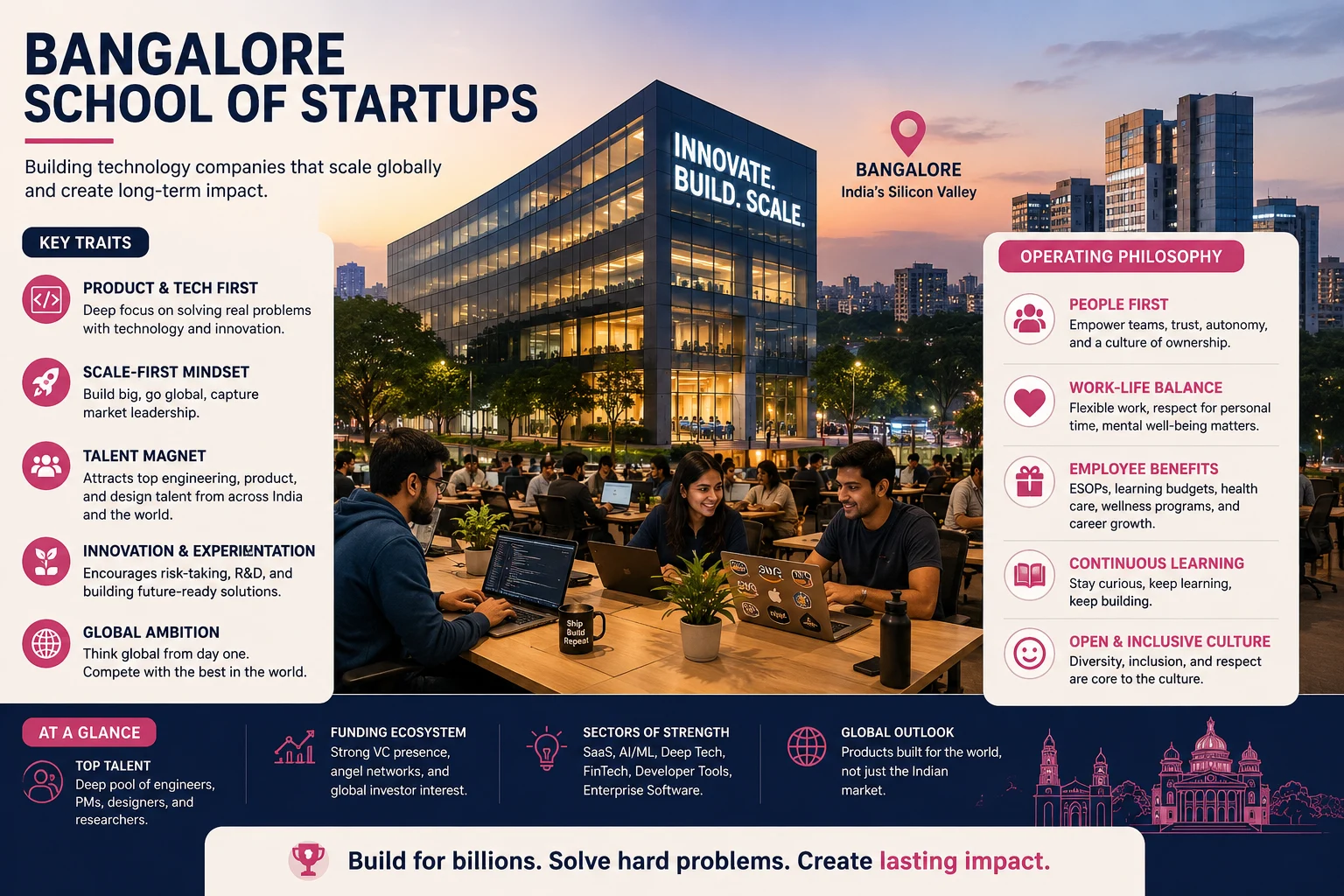
The Bangalore School of Startups is a technology-first, scale-first philosophy that prioritizes innovation, product excellence, user growth, and global ambition, believing that market leadership and long-term value creation often justify delaying profitability.
Core characteristics
- Product and technology as the primary competitive advantage
- Scale, network effects, and user adoption before optimization
- Global mindset from the outset
- VC-backed growth and willingness to take calculated risks
- Strong engineering and product culture
- Employee-centric workplace with flatter hierarchies and greater autonomy
- Long-term value creation over short-term profits
Mental model
Build a product millions love, then build the business around it.
2) Delhi School of Startups
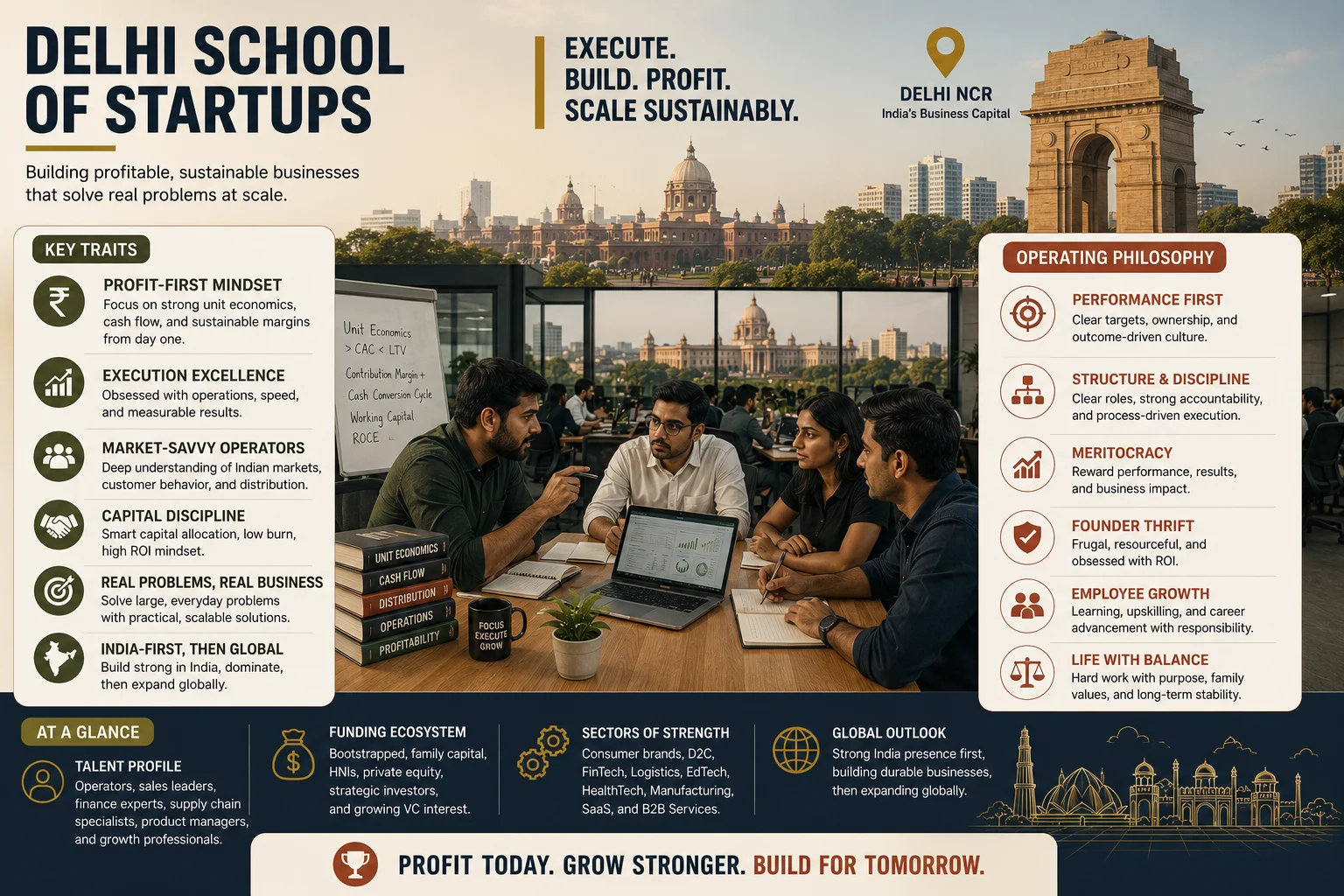
The Delhi School of Startups is a business-first, profit-first philosophy that prioritizes strong unit economics, disciplined execution, market understanding, and sustainable growth, believing that enduring companies are built on sound business fundamentals before aggressive scaling.
Core characteristics
- Business model and unit economics first
- Profitability and capital efficiency emphasized early
- Execution, sales, distribution, and operations as competitive strengths
- India-first approach before global expansion
- Disciplined use of capital and measurable ROI
- Performance-oriented leadership and accountability
- Sustainable, compounding growth over hypergrowth
Mental model
Build a business that makes money first, then scale it with confidence.
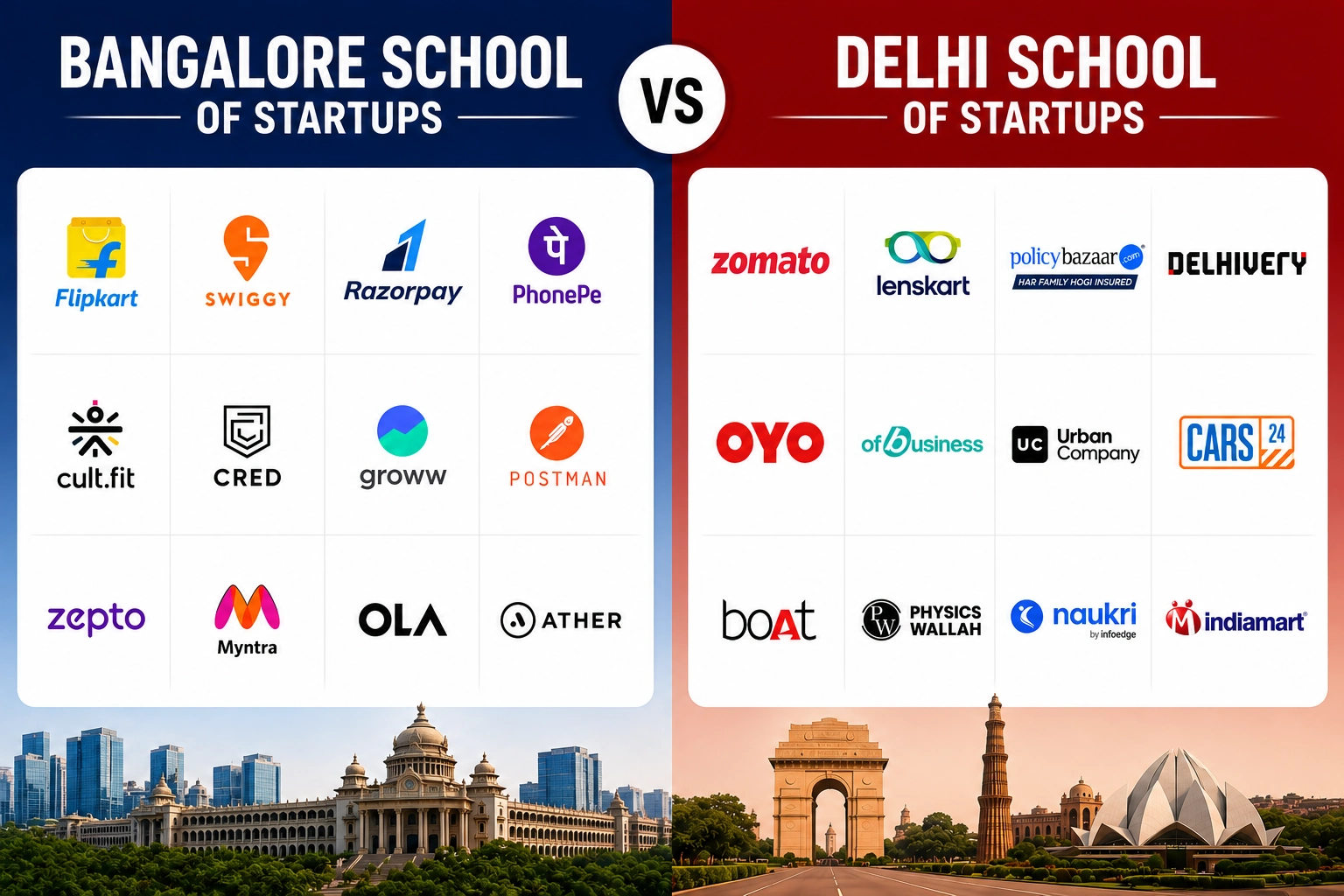
12 illustrative examples each
| # | Bangalore School of Startups | Why it fits the archetype | Delhi School of Startups | Why it fits the archetype |
|---|---|---|---|---|
| 1 | Flipkart | Scale, category creation, enormous user base and distribution before mature profitability | Zomato | Strong focus on marketplace economics, monetization and operational efficiency alongside scale |
| 2 | Swiggy | Consumer habit, network density and scale were central to the strategy | Lenskart | Omnichannel distribution, retail execution and unit economics |
| 3 | Razorpay | Technology/product infrastructure with ambitions to become a global payments platform | Policybazaar | Monetization and distribution-led insurance marketplace |
| 4 | PhonePe | Massive user adoption and payments network effects | Delhivery | Operational infrastructure, logistics economics and execution at scale |
| 5 | Cult.fit | Product experience, brand, aesthetics, lifestyle positioning and building a large consumer platform | OYO | Aggressive expansion combined with property-level economics and operational control |
| 6 | CRED | Product experience, brand, engagement and user ecosystem before conventional profitability | OfBusiness | B2B commerce built around transaction economics, working capital and financing |
| 7 | Groww | Simplifying investing for millions of users and building a huge consumer platform | Urban Company | Marketplace density, service economics, operational discipline and supply-side execution |
| 8 | Postman | Product-led growth, developer adoption and global SaaS ambitions | CARS24 | Distribution, inventory economics, operational infrastructure and transaction margins |
| 9 | Zepto | Extreme speed, aggressive user acquisition, distribution density and scale-first market capture | boAt | Consumer distribution, brand building, pricing and mass-market execution |
| 10 | Myntra | Product/category leadership, user adoption, aesthetics and fashion-commerce scale | Physics Wallah | Mass-market distribution, affordable pricing, operational leverage and strong monetization |
| 11 | Ola | Massive market ambition, aggressive expansion, technology platform and willingness to prioritize scale | Naukri (Info Edge) | Capital-efficient marketplace, strong cash generation, monetization and disciplined capital allocation |
| 12 | Ather Energy | Engineering, product design, technology, innovation and category creation in electric mobility | IndiaMART | Marketplace economics, sales/distribution network, monetization and long-term profitability |
Bengaluru’s ecosystem is particularly concentrated in fintech, enterprise technology, SaaS and consumer technology, with companies such as Flipkart, PhonePe, Razorpay, CRED, Zerodha, Groww and Postman among the prominent examples. (upGrad)
Delhi NCR’s ecosystem has a particularly strong representation in consumer businesses, fintech, logistics, commerce and operationally intensive businesses. Zomato, Lenskart, Policybazaar, Delhivery, OYO, Urban Company, OfBusiness, CARS24 and Physics Wallah are among the prominent companies associated with the region. (Dealroom)
The important caveat: Zerodha
Zerodha is the perfect example of why these aren’t geographical rules.
It is a Bengaluru company, yet its philosophy is almost the opposite of the “Bangalore = scale first” stereotype: it was bootstrapped, highly capital-efficient and profitable without VC funding. (eChai Ventures)
Likewise, Delhi NCR has companies that are extremely scale-oriented. Zomato, OYO, Lenskart and Urban Company are hardly conservative-growth businesses.
So I’d characterize the two schools this way:
Bangalore School: What could this become if we maximize product, technology, adoption and scale?
Delhi School: How do we turn this into a highly efficient, profitable and defensible business while scaling?
And the really interesting companies eventually converge toward both: Bangalore’s product/scale mentality + Delhi’s unit economics/execution discipline.
2 Important Additions to Delhi School of Startups
- IndiaMART and Info Edge belong very strongly on the Delhi side: both are excellent examples of the profit-first, capital-efficient model.
- Zerodha should be treated as a Bangalore exception, because its actual operating philosophy is much closer to the Delhi archetype we defined: profitability, capital efficiency and organic growth rather than VC-funded hypergrowth. Zerodha is Bengaluru-based, bootstrapped and highly profitable. (Moneycontrol)
Why IndiaMART and Info Edge are particularly important
IndiaMART is almost a textbook example of the Delhi-school philosophy: it spent years building the marketplace, sales organization and distribution network before institutional capital became significant. It is therefore much closer to “build the economics, then scale” than to the typical VC-first startup model.
Info Edge is an even stronger example. Founded in 1995, it built Naukri into a dominant recruitment platform, became a highly cash-generative internet business, and then used that financial strength to invest in companies such as Zomato and Policybazaar. Info Edge itself describes its model around strong cash-flow generation, profitability and entrepreneurial capital allocation. (Info Edge)
Its corporate base is firmly Delhi NCR: its registered office is in New Delhi and its corporate office is in Noida. (Info Edge)
A Nuance to understand this reality better;
Info Edge → Zomato is almost a perfect demonstration of the two schools interacting.
Info Edge represents the Delhi-style capital-efficient compounder.
Zomato represents the scale-first Delhi exception.
Info Edge actually invested in Zomato at an early stage and became a major shareholder. (Info Edge)
So the ecosystem isn’t 100% Bangalore = scale, Delhi = profit.
It’s more interesting:
Bangalore has a strong scale-first tradition, with profit-first exceptions such as Zerodha.
Delhi has a strong profit-first/business-building tradition, with enormous scale-first exceptions such as Zomato, OYO and Lenskart.
That makes the framework considerably more defensible.
Delhi School of Startups (some notes)
If you want something done faster and most efficiently, the Delhi School of Startups is the way to go. Build something today and start earning cash flow and profits as soon as possible, not just revenues. There might not be a lot of aesthetics or attention to detail here, but fundamentally, things are super strong, and all the essential functions work 110/100 times, or 95/100 times to be conservative. Everything IMPORTANT just works. Always. Reliably. Consistently. Even if not in the most fashionable or sophisticated way. UI/UX won’t be great or laudable. Only essential features and high performing features will be there in the applications. These establishments and people who work here have a lot of heart. Talents who work the hardest and are most passionate can be found here. A lot of Product Owners and top operators are built here. They often have to take the risks themselves. Very street-smart (dhanda/jugaad) professionals, who are never afraid to roll up their sleeves and fix the problems at hand, by themselves even. No problem is too small. They are Pure operators, Fixers (problem fixers) and efficiency is the name of the game here. You will get all the benefits if you are a stakeholder, because you are creating immense value for all stakeholders in this setup. Office and Infrastructure will be normal, functional and quite good at best. Nothing spectacular is aimed here, more emphasis is given on working on the business, rather than the good or nice to haves. Revenues and more importantly profits are the game here. That’s the end game, and mid term game. So they will have to sort out business goals, and unit economics as soon as possible, without playing around. There is high pressure or emphasis on becoming profitable.
Bangalore School of Startups (some notes)
If you want something big, newsworthy, viral, share-worthy, and laud-worthy or high-status to be done, with less regard/concern to efficiency, profits, or margins, the Bangalore School of Startups is the way to go. In other words, build it first and find unit economics and business sense much later. There will be a lot of attention to detail in the work done by Bangalore School of Startup examples. It will be aesthetic, fashionable, sophisticated, really good UI/UX, a lot of features, and optionality for users. There is a lot of love for the users, and people who work here are told to put themselves in the shoes of the users or think like a user and be more empathetic. A lot of peak intelligence (the country’s best brains that don’t go abroad) goes into the products. The best talents (most intelligent talents), professionals from colleges (Tier 1 and Tier 2), and MBAs. There is a lot of focus on innovation here, thinking about things from totally new and even absurd lenses, even if they do not make business sense. These guys are the best at user acquisition and oftentimes user satisfaction. Many times, the prices of services of Bangalore School of Startups will be higher than the equivalent in Delhi School of Startups. That’s the natural way, especially when companies mature and VCs and founders don’t burn cash to help in user acquisition. Status and image are super important for Bangalore School of Startups, founders, and employees. This will also lead to a good work-life balance, benefits, state of the infrastructure for offices, PlayStations, hybrid culture (with some acceptance of remote), lax office rules (no uniforms or dress code), relaxed or homely office furniture, and the likes. The office will feel more like an uptown bar or a luxury home.
(Actual) Importance of Location?
To be really honest, location is not that important, even though it says Bangalore and Delhi School of Startups. These are generalizations which help identify systems and companies better. There is high correlation, but it’s not mandatory, and there can always be exceptions, but it is against the norm and natural forces.
The whole topic of this article is mainly about a mentality, an attitude, a way of being, and a way of seeing businesses and having a certain vision for how businesses operate in general, a certain mental model. And it all starts to flow down from investors and founders. They set the tone, expectations, and direction.
In one sentence
Bangalore School: Build a category-defining product that becomes a great business.
Delhi School: Build a great business that becomes a category leader.
The fundamental difference
| Bangalore School | Delhi School |
|---|---|
| Product-first | Business-first |
| Scale-first | Profit-first |
| Technology moat | Execution moat |
| Innovation-led | Operations-led |
| User growth before optimization | Unit economics before hypergrowth |
| Global by design | India-first, then global |
Rather than being competing ideologies, these are best viewed as two different philosophies for building enduring companies. Many successful startups ultimately blend elements of both: they pursue Bangalore’s emphasis on product and innovation while adopting Delhi’s focus on disciplined execution and sustainable economics as they mature.
Factor | Bangalore School of Startups | Delhi School of Startups |
Quality of Talent | Strong concentration of software engineers, AI researchers, product managers, deep-tech founders, and experienced startup operators. | Strong talent in sales, business development, operations, finance, policy, logistics, and consumer business execution. Engineering talent exists but is less concentrated. |
Geography | Located in India’s technology hub with proximity to major global tech companies, engineering colleges, and startup ecosystems. | Located near India’s political and commercial capital, with access to government, large enterprises, manufacturing belts, and North Indian markets. |
Source of Funds | Venture Capital (VC), angel investors, global institutional investors, accelerator programs, corporate venture funds. | Family businesses, self-funded founders, profitable operations, HNIs, traditional businesses, private equity, and increasingly VC. |
What They Do with Funding | Invest heavily in product development, engineering, R&D, AI, hiring talent, customer acquisition, and rapid scaling. | Invest more in sales, distribution, inventory, marketing, expansion, operations, and building business infrastructure. |
Ambition & Risk Appetite | High-risk, high-reward mindset. Comfortable pursuing billion-dollar outcomes, global markets, and disruptive innovation despite years of losses. | Generally more focused on profitable growth, market dominance, and building sustainable businesses. Risk-taking exists but often has clearer paths to revenue. |
Work-Life Balance | Often intense startup culture with long working hours, especially during early growth stages. | Typically demanding as well, but many founder-led businesses emphasize sustainable operations and family life more than hyper-growth startups. |
Typical Number of Employees | Early-stage tech startups may begin with 5–30 employees, scaling to 100–500+ rapidly if successful. | Traditional and commerce-oriented startups often reach 20–200 employees earlier due to sales, operations, warehousing, and customer support needs. |
Expenses | High salaries for engineering talent; relatively asset-light. Major costs include payroll, cloud infrastructure, and software. | Higher operational expenses including offices, inventory, logistics, distribution, sales teams, and physical infrastructure where applicable. |
Mission | Build globally competitive technology products capable of transforming industries. | Build scalable businesses that capture large markets, generate profits, and solve commercial problems across India. |
Vision | Create category-defining companies through innovation, technology, and intellectual property. | Build enduring businesses with strong market leadership, operational excellence, and sustainable wealth creation. |
Quality of Life (Work & Lifestyle) | Generally places greater emphasis on employee well-being, flexible work arrangements, learning opportunities, modern office culture, ESOPs, wellness benefits, and collaborative environments. After work, employees often have more time for networking events, hobbies, fitness, meetups, and personal development, though this varies by startup stage. | Generally more performance- and outcome-driven, with a stronger focus on execution, growth, and commercial results. Long working hours are more commonly accepted in founder-led businesses, especially in sales and operations. Benefits are improving but are often secondary to business performance, and after-work life may be more limited during periods of rapid expansion.
|
Leadership & Workplace Philosophy | Generally leans toward a more employee-centric management style. Greater emphasis on flexible work, ESOPs, learning budgets, mental well-being, flatter hierarchies, autonomy, and long-term talent retention. Leaders are often more willing to trade some short-term efficiency for employee satisfaction and innovation. | Generally leans toward a more execution- and performance-centric management style. Greater emphasis on accountability, discipline, rapid execution, measurable outcomes, and commercial performance. Benefits and flexibility are valued but are more often viewed as tools to improve productivity rather than ends in themselves. |
Management Culture | More workplace-liberal: employee empowerment, flexibility, work-life balance, inclusive culture, and modern HR practices. | More workplace-conservative: structured management, performance discipline, hierarchy, ownership, and execution-first culture. |
Growth Philosophy | Scale-first. Prioritizes building products that become habitual, achieve network effects, capture large user bases, and establish market leadership. Profitability may be deliberately deferred if scale strengthens long-term competitive advantage. Unit economics are expected to improve with maturity. | Profit-first. Prioritizes strong unit economics, positive cash flow, sustainable margins, and disciplined capital allocation from an earlier stage. Scale is pursued, but not typically at the expense of long-term financial sustainability. |
Bangalore School | Delhi School |
User Base → Distribution → Scale → Profitability | Unit Economics → Profitability → Sustainable Scale |
The underlying mental models
Bangalore School
- Win the market first.
- Build user habits and product stickiness.
- Achieve network effects.
- Monetization can follow once leadership is established.
- “A great product eventually becomes a great business.”
Delhi School
- Build a business that makes economic sense from the outset.
- Validate unit economics early.
- Grow through disciplined execution.
- Expansion should strengthen profitability, not dilute it.
- “A great business eventually becomes a market leader.”
This distinction aligns reasonably well with historical patterns in India’s startup ecosystem. Bangalore has been more associated with VC-backed software and platform businesses that can justify delayed profitability in pursuit of scale, while Delhi NCR has had a stronger presence of commerce, logistics, D2C, and operationally intensive businesses where healthy unit economics tend to be emphasized earlier. There are notable exceptions—particularly in sectors like quick commerce and fintech—but as an ecosystem-level comparison, this captures a meaningful difference in philosophy.
Chapter 2:
How they Get Capital/Funds:
Bangalore (Bengaluru) remains the deeper, more mature pure-tech VC hub, while Delhi-NCR leverages policy proximity, corporate density, consumer markets, and a growing mix of angels + late-stage capital — with some periods of stronger relative funding shares.
Both ecosystems rely primarily on private capital (angels, micro-VCs, institutional VCs, family offices). Differences arise in density of investors, sector fit, non-dilutive/government leverage, networks, and typical paths to capital.
Funding Volumes and Trends (Recent Data)
- Bangalore: Consistently leads annual venture volume. Around $2.5 billion in 2025 (largest city share). Strong historical cumulative totals (tens of billions since 2010). Dominates unicorn count and deep-tech/SaaS scaling.
- Delhi-NCR: Second place, roughly $1.5–2.2 billion in 2025 (figures vary by source; some periods higher). In Q1 2025 it captured ~40% of national tech funding in some reports, ahead of Bangalore. Strong late-stage activity (mega-rounds in auto-tech, logistics, etc.) and claims of better capital efficiency/exits relative to capital raised in certain analyses.
National funding remains highly concentrated in the top three metros (Bangalore, Delhi-NCR, Mumbai), which together take the large majority.
Bangalore Model: How Startups Access Capital
Core strengths: Engineering talent density (IISc, IITs, large GCC presence), serial founders, product depth in B2B SaaS, enterprise software, deep tech, fintech, and healthtech. This attracts global and domestic VCs seeking scalable tech.
Typical path:
- Early stage: Tech-savvy angels and platforms (LetsVenture is frequently cited), local angel networks, micro-VCs, and accelerators.
- Seed to Series A+: Dense local VC ecosystem. Karnataka hosts a large concentration of VC firms. Global funds (and their India arms) are heavily present because of the track record.
- Government support (mature): Karnataka’s Elevate scheme offers equity-free grants up to ₹50 lakh for proof-of-concept/prototype. Additional reimbursements for patents, international marketing, GST (in certain cases), and strong incubation infrastructure. State policy is long-established and multi-sector.
Style: Higher emphasis on technical moats and growth velocity. Investors often underwrite based on product quality, engineering talent, and long-term scalability. Culture leans toward tech-first building; higher valuations are more common for strong SaaS/deep-tech stories, but burn rates can also be higher.
Delhi-NCR Model: How Startups Access Capital
Core strengths: Proximity to central government/policymakers, high density of corporate HQs (especially Gurgaon), large North Indian consumer market with higher per-capita income in some metrics, and strengths in consumer (D2C/quick commerce), logistics, edtech, govtech, and more recently auto-tech.
Typical path:
- Early stage: Active seed players include Venture Catalysts, Inflection Point Ventures, and India Accelerator. Indian Angel Network (IAN) is headquartered in Delhi and is one of India’s largest angel platforms (mentorship + capital, national reach, focus areas including healthcare, fintech, consumer).
- Growth/late stage: Mix of institutional VCs, family offices, sovereign funds, and strategic/corporate capital. Large late-stage rounds have been notable.
- Government & policy leverage: Draft Delhi Startup Policy 2025 proposes a ₹200 crore state VC fund (designed for co-investment to crowd in private capital), operational grants, lease/rental support for co-working, patent reimbursements, and a single-window portal. This is newer and smaller-scale than Karnataka’s mature system but signals intent. Central schemes (Startup India Seed Fund, etc.) are also accessible. Policy proximity helps with govtech pilots, regulatory navigation, and public-sector related opportunities.
Style: More market- and execution-oriented. Founders often use local traction, corporate partnerships, or consumer density to demonstrate metrics before or during fundraising. Some commentary highlights greater frugality and capital efficiency (leading to claims of stronger relative exit performance despite lower cumulative funding). Networking can feel more corporate/policy-adjacent.
Key Comparative Differences
Aspect | Bangalore | Delhi-NCR |
Dominant capital | Pure-play VCs + international funds | Angels + accelerators + growing VCs + corporate/strategic + family offices |
Early-stage networks | Tech angels, LetsVenture, local VCs | IAN (HQ), Venture Catalysts, Inflection Point, India Accelerator |
Government leverage | Mature grants (Elevate up to ₹50L), reimbursements, incubators | Emerging ₹200 Cr VC fund + grants/reimbursements; strong policy access |
Sector pull | B2B SaaS, deep tech, enterprise, healthtech | Consumer/D2C, logistics, edtech, govtech, auto-tech |
Investor thesis | Product/tech depth + talent + scalability | Traction, market access, corporate/gov partnerships, capital efficiency |
Cultural note | Tech-first, growth narratives common | More revenue/profit pragmatism in some founder views; policy & corporate networks |
Practical Takeaways
- Bangalore is generally stronger if you are building deep tech, complex B2B SaaS, or need large amounts of growth capital from specialized tech investors. The density of relevant VCs and talent makes warm intros and technical due diligence smoother.
- Delhi-NCR can be advantageous for consumer, logistics, policy-adjacent, or capital-efficient businesses that can convert market access or corporate relationships into revenue or strategic capital. Location helps with non-dilutive or hybrid funding routes.
- Both cities access the same national instruments (Startup India Seed Fund, SIDBI funds, etc.). State-level differences matter more at the margin for early grants and soft support.
- Funding is cyclical and selective everywhere. Recent years show capital concentrating on stronger metrics regardless of city; pure “location arbitrage” is limited.
The ecosystems are complementary rather than strictly zero-sum. Many investors operate nationally, and founders increasingly raise across cities. Bangalore still holds the structural edge in pure venture density and historical scale, while Delhi-NCR has closed gaps through market advantages, policy efforts, and strong late-stage activity in specific sectors.
Chapter 3:
Average Funding Composition
Here is a clear breakdown of average funding composition for Bangalore-model vs Delhi-NCR model startups, by type and by origin of funds.
Important note: No public report publishes exact city-level percentage averages for every funding type and investor nationality. The figures below are reasoned averages synthesized from Bain-IVCA reports (2025–2026), Inc42/Tracxn data, ecosystem patterns, and investor activity. They reflect typical capital mixes rather than precise audited city averages.
1. Composition by Type of Capital
Funding Type | Bangalore Model (Avg %) | Delhi-NCR Model (Avg %) | Comments |
Institutional VC / Growth Equity | 55–65% | 40–55% | Bangalore has denser pure-play tech VCs |
Angels / Micro-VCs / Syndicates | 15–25% | 20–30% | Delhi stronger via IAN + local networks |
Corporate VCs / Strategic | 8–15% | 15–25% | Delhi benefits from corporate HQ density |
Family Offices | 5–10% | 8–15% | Rising in both, slightly higher in Delhi |
Government / Non-dilutive Grants | 5–10% | 8–15% | Delhi rising with new ₹200 Cr state VC fund + policy access |
Debt / Revenue-based / Others | 3–8% | 5–10% | Still small in both |
Key takeaway on type:
Bangalore funding is more VC-dominated (especially growth-stage institutional capital).
Delhi-NCR funding is more hybrid — higher relative share from angels, corporates, family offices, and policy-linked capital.
2. Composition by Origin of Funds (Country / Region)
Origin of Capital | Bangalore Model (Avg %) | Delhi-NCR Model (Avg %) | Notes |
India (Domestic) | 35–45% | 45–55% | Domestic share is rising overall; higher in Delhi due to angels + corporates |
United States | 25–35% | 18–28% | Strongest in Bangalore (SaaS/deeptech preference by US VCs) |
Singapore | 12–18% | 12–18% | Major hub for fund domicile (Temasek, GIC, many India-focused funds) |
Middle East (UAE, Saudi, etc.) | 5–10% | 6–12% | Growing, especially late-stage |
Europe + Others (UK, Japan, etc.) | 8–12% | 8–12% | Includes SoftBank historical, European funds, etc. |
Key takeaways on origin:
- Foreign capital still accounts for the majority of value (especially Series B+ and mega-rounds) in both cities, but the share of domestic capital is meaningfully higher in Delhi-NCR.
- Bangalore attracts a higher proportion of pure US tech VC capital because of its SaaS, enterprise, and deep-tech orientation.
- Delhi-NCR sees relatively more Indian domestic capital (angels, family offices, corporate strategic money) and slightly higher Middle East participation in certain large rounds.
- Singapore acts as a major domicile for both foreign and India-focused funds in both ecosystems.
Summary Comparison
Dimension | Bangalore Model | Delhi-NCR Model |
Dominant capital type | Institutional VC / Growth Equity | More balanced (VC + Angels + Corporate) |
Domestic vs Foreign | Slightly more foreign-heavy (esp. US) | Higher domestic share |
Early-stage flavour | Tech angels + micro-VCs | Stronger angel networks (IAN etc.) |
Late-stage flavour | Global growth funds | Mix of global + corporate + family offices |
Policy / Non-dilutive | Mature state grants (Elevate etc.) | Emerging dedicated state VC fund + proximity |
Bottom line:
- Bangalore model = Higher concentration of professional institutional VC money, with a stronger US tech capital flavour.
- Delhi model = Broader mix with more domestic angels, corporate/strategic capital, and growing policy support.
Chapter 4:
Early Stage vs Late Stage Funding Composition
Early-stage vs Late-stage Funding Composition
Here is the refined breakdown for Bangalore Model and Delhi-NCR Model startups, split by stage.
Definitions used
- Early-stage: Pre-seed + Seed + Series A
- Late-stage: Series B and beyond (including growth equity / late PE)
Figures are reasoned averages based on Indian ecosystem patterns (Bain-IVCA, Inc42/Tracxn trends, investor activity). Exact city-level audited splits are not published, so these reflect typical capital mixes.
1. By Type of Capital
Early-Stage Composition
Funding Type | Bangalore Model | Delhi-NCR Model | Key Difference |
Angels / Micro-VCs / Syndicates | 35–45% | 40–50% | Delhi slightly higher (stronger IAN & local networks) |
Institutional VC (Seed/Series A) | 35–45% | 25–35% | Bangalore denser with professional seed VCs |
Corporate / Strategic | 5–10% | 10–15% | Delhi higher due to corporate HQ access |
Family Offices | 5–8% | 8–12% | Slight edge to Delhi |
Government / Non-dilutive Grants | 8–12% | 10–15% | Both use central schemes; Delhi gaining with new state fund |
Others (Debt, Accelerators, etc.) | 3–7% | 3–7% | Similar |
Early-stage summary:
Both cities are still heavily domestic and angel/micro-VC driven. Bangalore has a more professionalized seed VC layer. Delhi relies more on angel networks + corporate relationships.
Late-Stage Composition
Funding Type | Bangalore Model | Delhi-NCR Model | Key Difference |
Institutional VC / Growth Equity | 60–70% | 50–60% | Bangalore more pure growth-VC oriented |
Corporate VCs / Strategic | 10–15% | 15–25% | Delhi stronger corporate/strategic flavour |
Family Offices / Sovereign | 8–12% | 10–15% | Comparable, slightly higher in Delhi |
PE / Large Growth Funds | 8–12% | 8–12% | Similar |
Government / Others | 2–5% | 3–6% | Minimal at this stage |
Late-stage summary:
Both shift heavily toward institutional capital. Bangalore remains more classic growth-VC driven. Delhi shows a meaningfully higher share of corporate/strategic money.
2. By Origin of Funds (Country/Region)
Early-Stage Origin
Origin | Bangalore Model | Delhi-NCR Model | Notes |
India (Domestic) | 70–80% | 75–85% | Dominates early stage in both |
United States | 10–15% | 5–10% | Higher in Bangalore (tech founders attract US seed interest) |
Singapore | 5–8% | 5–8% | Mostly via India-focused funds |
Middle East + Others | 5–8% | 5–8% | Limited at this stage |
Early-stage reality: Overwhelmingly Indian capital (angels + domestic micro-VCs) in both cities.
Late-Stage Origin
Origin | Bangalore Model | Delhi-NCR Model | Notes |
India (Domestic) | 25–35% | 35–45% | Delhi retains higher domestic share |
United States | 30–40% | 20–30% | Strongest in Bangalore (SaaS/deep-tech preference) |
Singapore | 15–20% | 15–20% | Major domicile for growth capital in both |
Middle East | 5–10% | 8–12% | Growing, slightly more visible in Delhi large rounds |
Europe + Others | 8–12% | 8–12% | Includes UK, Japan, etc. |
Late-stage reality: Foreign capital becomes the majority by value in both cities, but Bangalore is more US-heavy while Delhi keeps a higher domestic + corporate/Middle East mix.
Quick Comparative Snapshot
Stage | Bangalore Advantage | Delhi-NCR Advantage |
Early | More professional seed VCs + tech angels | Stronger pure angel networks + corporate access |
Late | Deeper global growth VC (especially US) | Higher corporate/strategic + domestic capital |
Overall | Cleaner institutional VC pathway | More hybrid (angel → corporate → growth) path |
Chapter 5:
Typical Cheque Size Ranges by Stage & City (2025–2026)
These are realistic ranges based on current Indian startup funding data (GrowthList, Inc42/Tracxn patterns, and market activity). Ranges reflect most common deal sizes, not extremes or mega-outliers.
Early-Stage Cheque Sizes
Stage | Bangalore Model | Delhi-NCR Model | Notes |
Pre-seed | $150K – $600K (₹1.25 Cr – ₹5 Cr) | $100K – $500K (₹85L – ₹4.2 Cr) | Bangalore slightly higher for strong tech founders |
Seed | $500K – $3M (₹4 Cr – ₹25 Cr) | $400K – $2.5M (₹3.3 Cr – ₹21 Cr) | Bangalore upper end more common for SaaS/deep-tech |
Series A | $4M – $18M (₹33 Cr – ₹150 Cr) | $3M – $15M (₹25 Cr – ₹125 Cr) | Bangalore tends to command higher valuations & tickets for product-led startups |
Early-stage pattern:
Bangalore cheques are generally 10–25% larger on average for comparable quality, especially in B2B SaaS and deep-tech. Delhi deals can be more traction/metric-driven and sometimes more capital-efficient.
Late-Stage Cheque Sizes
Stage | Bangalore Model | Delhi-NCR Model | Notes |
Series B | $15M – $50M (₹125 Cr – ₹420 Cr) | $12M – $45M (₹100 Cr – ₹375 Cr) | Comparable; Bangalore edges higher on pure growth VC deals |
Series C | $40M – $120M (₹330 Cr – ₹1,000 Cr) | $30M – $100M+ (₹250 Cr – ₹850 Cr+) | Delhi can match or exceed in consumer, logistics, auto-tech mega-rounds |
Series D+ / Growth | $80M – $300M+ | $50M – $250M+ | Large outliers exist in both (e.g., quick commerce, fintech, auto) |
Late-stage pattern:
- Bangalore dominates classic institutional growth rounds (especially SaaS/enterprise).
- Delhi-NCR frequently sees large strategic or corporate-backed rounds and has produced some of the biggest tickets in consumer, logistics, and mobility/auto-tech.
Quick Practical Summary
Stage | Typical Bangalore Advantage | Typical Delhi-NCR Advantage |
Pre-seed/Seed | Higher tickets for tech talent & product | Stronger angel network access, sometimes easier entry |
Series A | Better pricing power on strong SaaS | More flexible on traction & corporate partnerships |
Series B+ | Deeper pure growth VC pool | Competitive large rounds + strategic capital |
Important context:
- These are median-to-typical ranges. Top 10–15% of deals in both cities go significantly higher.
- Valuation and dilution matter more than absolute cheque size. Bangalore startups often raise at higher valuations for the same stage.
- Post-2023 correction, investors in both cities are more disciplined — cheque sizes have moderated from the 2021–22 peaks.
Chapter 6:
Typical Valuation Ranges by Stage (Pre-money, 2025–2026)
These are realistic ranges for quality startups in the current Indian market. Valuations vary significantly based on sector (SaaS/deep-tech usually higher), traction, team, and investor competition. Bangalore generally commands a modest premium over Delhi-NCR for pure tech/product-led companies.
Early-Stage Valuations
Stage | Bangalore Model | Delhi-NCR Model | Notes |
Pre-seed | $1.5M – $6M (₹12 – 50 Cr) | $1M – $5M (₹8 – 42 Cr) | Mostly founder + angel driven. Strong teams get the upper end. |
Seed | $5M – $18M (₹42 – 150 Cr) | $4M – $15M (₹33 – 125 Cr) | Bangalore higher for SaaS/deep-tech. Delhi more traction-dependent. |
Series A | $18M – $55M (₹150 – 460 Cr) | $15M – $45M (₹125 – 375 Cr) | Clear product-market fit + early revenue expected. Bangalore edges higher on tech multiples. |
Early-stage pattern:
Bangalore valuations are typically 15–30% higher for comparable tech startups due to denser VC competition and global investor interest. Delhi can close the gap (or exceed) when strong unit economics or corporate traction is demonstrated.
Late-Stage Valuations
Stage | Bangalore Model | Delhi-NCR Model | Notes |
Series B | $60M – $180M (₹500 – 1,500 Cr) | $50M – $150M (₹420 – 1,250 Cr) | Growth + clear path to scale. |
Series C | $150M – $400M+ (₹1,250 – 3,300 Cr+) | $120M – $350M+ (₹1,000 – 2,900 Cr+) | Delhi competitive in consumer, logistics, and auto-tech mega-rounds. |
Series D+ / Growth | $300M – $1B+ | $250M – $800M+ | Large outliers exist in both cities. |
Late-stage pattern:
- Bangalore maintains an edge in pure software/SaaS growth valuations.
- Delhi-NCR frequently matches or exceeds in high-traction consumer, quick commerce, logistics, and mobility deals (especially when strategic/corporate capital is involved).
Key Context for 2025–2026
- Valuations remain well below 2021–22 peaks (often 30–50% lower for similar metrics).
- SaaS / AI / Deep-tech startups in Bangalore can command 20–40% premiums over the ranges above.
- Consumer / Logistics / D2C startups in Delhi-NCR often price more on revenue multiples and market leadership than pure tech multiples.
- Strong domestic capital + rising family office participation is supporting valuations in both cities, but global funds still drive the upper end of the range.
Chapter 7:
Typical Dilution Percentages by Stage
These are the median equity percentages sold in each round (how much ownership founders + existing shareholders give up in that specific round). Data is based on current market norms (Carta and Indian ecosystem patterns for 2025–2026).
Dilution by Stage
Stage | Bangalore Model | Delhi-NCR Model | Typical Range (Both Cities) | Notes |
Pre-seed | 12–18% | 12–20% | 10–20% | Higher if raising larger pre-seed |
Seed | 18–22% | 18–25% | 15–25% | Most common is ~20% |
Series A | 15–20% | 16–22% | 15–25% | Median around 18% |
Series B | 12–17% | 12–18% | 12–20% | Median around 14% |
Series C | 8–13% | 9–14% | 8–15% | Median around 10% |
Series D+ | 6–10% | 7–12% | 6–12% | Declines further in later rounds |
Key Differences Between the Two Cities
Factor | Bangalore | Delhi-NCR |
Overall dilution tendency | Slightly lower | Slightly higher |
Reason | Higher valuations → less equity given for same capital | More traction/corporate-driven pricing can sometimes lead to higher dilution |
Early-stage (Seed/A) | More competitive → better pricing power | Angel-heavy rounds can sometimes be more dilutive |
Late-stage | Cleaner institutional terms | Strategic/corporate investors may ask for more equity or special rights |
Practical reality:
- The difference between Bangalore and Delhi is usually only 1–3 percentage points.
- Strong traction, revenue, or a competitive process matters far more than the city.
- High-quality SaaS/deep-tech startups in Bangalore often dilute at the lower end of the range.
- Consumer/logistics startups in Delhi that raise large strategic rounds can sometimes dilute more than pure VC rounds.
Cumulative Founder Ownership (Approximate)
Assuming two co-founders start with 100% and raise normal rounds:
After Round | Typical Combined Founder Ownership |
After Seed | 65–75% |
After Series A | 45–55% |
After Series B | 35–45% |
After Series C | 25–35% |
Chapter 8:
Sample Cap Table Progression
(Typical Bangalore vs Delhi-NCR Startup)
Assumptions used:
- Two co-founders start with 50% / 50% ownership
- Clean rounds (no major option pool top-ups shown separately for simplicity)
- Dilution and valuations aligned with the ranges we discussed earlier
- “ESOP / Option Pool” is created/expanded at Seed and Series A (common practice)
Bangalore Model Startup (Tech / SaaS leaning)
Stage | Amount Raised | Pre-Money Valuation | Dilution | Founder 1 | Founder 2 | Investors (Cumulative) | ESOP Pool | Notes |
Founding | — | — | — | 50.0% | 50.0% | 0% | 0% | — |
Pre-seed | $400K | $3.5M | 15% | 42.5% | 42.5% | 15% | 0% | Angels / micro-VC |
Seed | $2.0M | $10M | 20% | 32.3% | 32.3% | 30.4% | 5%* | *ESOP created |
Series A | $10M | $40M | 18% | 25.0% | 25.0% | 42.0% | 8% | ESOP topped up |
Series B | $30M | $120M | 15% | 20.4% | 20.4% | 52.2% | 7% | Growth capital |
Series C | $75M | $300M | 12% | 17.5% | 17.5% | 58.5% | 6.5% | — |
Bangalore pattern: Higher valuations help founders retain relatively better ownership, especially from Series A onwards.
Delhi-NCR Model Startup (Consumer / Logistics / Hybrid leaning)
Stage | Amount Raised | Pre-Money Valuation | Dilution | Founder 1 | Founder 2 | Investors (Cumulative) | ESOP Pool | Notes |
Founding | — | — | — | 50.0% | 50.0% | 0% | 0% | — |
Pre-seed | $300K | $2.5M | 17% | 41.5% | 41.5% | 17% | 0% | Stronger angel network |
Seed | $1.5M | $8M | 22% | 30.5% | 30.5% | 32.5% | 6.5%* | *ESOP created |
Series A | $8M | $32M | 20% | 23.0% | 23.0% | 45.5% | 8.5% | More traction-driven |
Series B | $25M | $100M | 16% | 18.5% | 18.5% | 55.5% | 7.5% | Mix of VC + strategic |
Series C | $60M | $250M | 13% | 15.6% | 15.6% | 61.8% | 7% | — |
Delhi-NCR pattern: Slightly higher early dilution (especially Seed & Series A) due to lower average valuations and more angel/corporate participation. Ownership gap vs Bangalore usually stays in the 2–4 percentage point range by Series C.
Side-by-Side Summary (Combined Founder Ownership)
After Stage | Bangalore Model | Delhi-NCR Model | Difference |
After Seed | 64.6% | 61.0% | +3.6% |
After Series A | 50.0% | 46.0% | +4.0% |
After Series B | 40.8% | 37.0% | +3.8% |
After Series C | 35.0% | 31.2% | +3.8% |
Key Takeaways
- The ownership gap between a typical Bangalore tech startup and a Delhi-NCR hybrid/consumer startup is usually modest (3–4%) by Series C.
- Higher valuations in Bangalore are the main reason founders retain slightly more equity.
- In both cities, the biggest dilution hits happen at Seed + Series A.
- Creating a proper ESOP pool early (10–15% by Series A) is standard and healthy for talent.
Chapter 9:
Sample Cap Table with Larger Option Pool + Employee Dilution Impact
This version uses more realistic option pool practices common in Indian startups:
- Option pool is created / expanded before the round (pre-money dilution)
- Target available pool of 12–15% by Series A
- Later rounds include smaller top-ups
- Shows the combined effect of investor dilution + employee option pool
Bangalore Model Startup (Tech / SaaS)
Stage | Amount Raised | Pre-Money | Dilution to Investors | Option Pool Action | Founder 1 | Founder 2 | All Investors | Available ESOP | Notes |
Founding | — | — | — | — | 50.0% | 50.0% | 0% | 0% | — |
Pre-seed | $400K | $3.5M | 15% | — | 42.5% | 42.5% | 15% | 0% | Angels |
Seed | $2.0M | $10M | 18% | Create 12% pool (pre-money) | 30.0% | 30.0% | 28% | 12% | Heavy early ESOP creation |
Series A | $10M | $40M | 17% | Top-up to 15% available | 23.0% | 23.0% | 39% | 15% | Standard healthy pool |
Series B | $30M | $120M | 14% | Small top-up (+2%) | 18.9% | 18.9% | 48.2% | 14% | Pool slightly diluted |
Series C | $75M | $300M | 11% | Top-up to maintain ~12% | 16.3% | 16.3% | 55.4% | 12% | — |
Bangalore Founder Ownership after Series C: 32.6% combined
Delhi-NCR Model Startup (Consumer / Logistics / Hybrid)
Stage | Amount Raised | Pre-Money | Dilution to Investors | Option Pool Action | Founder 1 | Founder 2 | All Investors | Available ESOP | Notes |
Founding | — | — | — | — | 50.0% | 50.0% | 0% | 0% | — |
Pre-seed | $300K | $2.5M | 17% | — | 41.5% | 41.5% | 17% | 0% | Angels |
Seed | $1.5M | $8M | 20% | Create 13% pool (pre-money) | 28.0% | 28.0% | 31% | 13% | Slightly higher early pool |
Series A | $8M | $32M | 19% | Top-up to 15% available | 21.0% | 21.0% | 43% | 15% | — |
Series B | $25M | $100M | 15% | Small top-up (+2%) | 17.0% | 17.0% | 52% | 14% | — |
Series C | $60M | $250M | 12% | Top-up to maintain ~12% | 14.5% | 14.5% | 59% | 12% | — |
Delhi-NCR Founder Ownership after Series C: 29.0% combined
Side-by-Side Comparison (Combined Founder Ownership)
After Stage | Bangalore Model | Delhi-NCR Model | Difference |
After Seed | 60.0% | 56.0% | +4.0% |
After Series A | 46.0% | 42.0% | +4.0% |
After Series B | 37.8% | 34.0% | +3.8% |
After Series C | 32.6% | 29.0% | +3.6% |
Important Notes on Option Pool Impact
- Pre-money pool creation is the biggest hidden dilution. Creating a 12–15% pool at Seed/Series A significantly reduces founder ownership early.
- Bangalore founders still end up with ~3.5–4% more equity by Series C mainly because of higher valuations.
- In both cities, a healthy 12–15% available option pool by Series A is now expected by good VCs.
- Actual employee dilution depends on how much of the pool is granted and vested. Many startups grant 40–60% of the pool by Series C.
Associated Content
A Deep Dive into Zomato, Swiggy, and the Food Delivery Business
If you liked this Post, also check these out